Seven Who Served Power, One Who Served Truth
A sequence of eight sonnets inspired by the Mahabharata
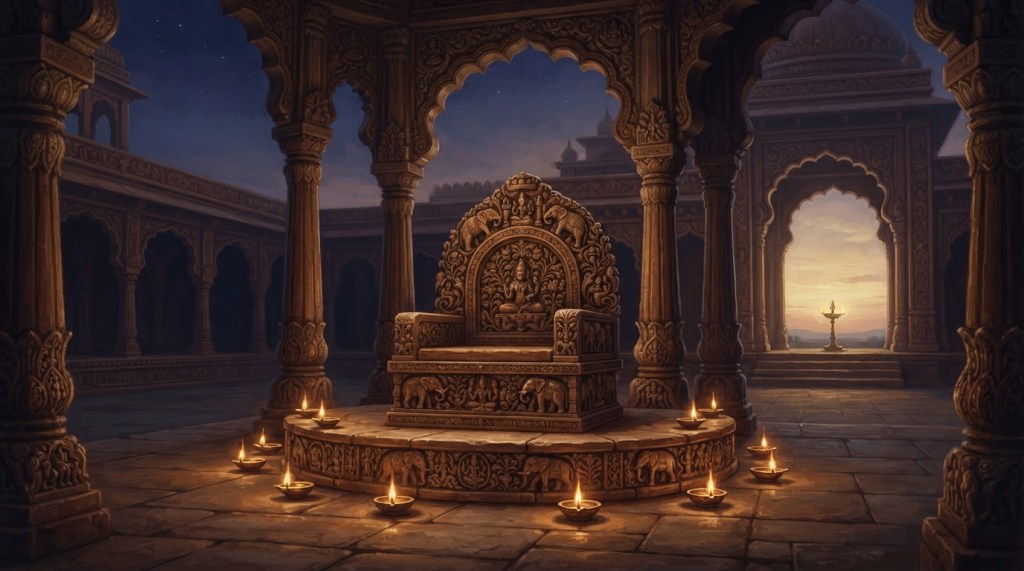
The throne of Hastinapura was surrounded by extraordinary minds, formidable warriors, and devoted companions. Yet wisdom, courage, and loyalty did not always lead to righteousness.
These eight sonnets explore the different faces of allegiance—and the one voice that refused to surrender its conscience.
Sonnet I — Shakuni
The Architect of Division
He whispered where the seeds of envy grew,
And dressed resentment in the robes of right;
He turned each doubtful thought to something true,
And made suspicion seem like second sight.

He cast the dice with cunning in his hand,
And taught a prince to fear another’s gain;
Where wisdom might have healed a wounded land,
He planted pride and cultivated pain.

For those who flatter anger feed its flame,
And make ambition deaf to wiser pleas;
They promise crowns and everlasting fame,
While bringing mighty kingdoms to their knees.

Beware the voice that feeds your darkest fear;
It may be plotting ruin while held dear.
Sonnet II — Dushasana
The Servant of Blind Obedience
He stood beside his brother, fierce and proud,
And never questioned what his master willed;
His conscience disappeared beneath the crowd,
As every cruel command was swiftly filled.

He called it loyalty, he called it trust,
And followed where his brother chose to lead;
Yet duty turned to ashes in the dust,
When blind obedience sanctified the deed.

For loyalty that cannot question wrong
Becomes the weapon tyranny employs;
The weakest conscience in a cheering throng
May help destroy what centuries enjoyed.

The truest strength is knowing when to cease;
No blind allegiance ever purchases peace.
Sonnet III — Karna
The Prisoner of Gratitude
A friend once raised him when the world looked down,
And gave him honor others had denied;
In gratitude, he pledged his sword and crown,
And bound his fate forever to that side.

His heart held courage, generosity, pride,
Yet friendship drew a line he would not cross;
He saw the shadows gathering beside,
But feared betrayal more than coming loss.

How noble is the debt that kindness earns,
How dangerous when conscience pays its price;
For gratitude that never questions turns
A generous heart toward tragic sacrifice.

Be grateful to the hands that helped you rise;
But never let that debt conceal your eyes.
Sonnet IV — Dhritarashtra
The Blindness of Attachment
He heard the warnings echo through the hall,
Yet love restrained the justice of his hand;
He watched through others as the shadows fall,
And let ambition overtake the land.

A father’s heart could not deny his son,
A monarch’s duty called for sterner care;
Between the two, the darker choice was done,
And silence settled heavily in air.

For love that never disciplines or guides
May nourish what it desperately should tame;
And when a ruler from his duty hides,
The innocent must often bear the blame.

To love is not to grant each wish its way;
Sometimes love means the courage to say nay.
Sonnet V — Bhishma
The Prisoner of His Promise
He stood a giant among lesser men,
His word a vow no hardship could undo;
Yet when injustice entered court again,
His ancient promise held him to the few.

He knew the path of righteousness and grace,
He saw the wrong, the cruelty, and the cost;
But duty kept him rooted in his place,
Until the greater purpose had been lost.

What worth a vow that binds the hands of right?
What honor lives where conscience cannot speak?
A promise made to guard the kingdom’s light
Must never leave its helpless people weak.

When duty and our deepest values part,
Let wisdom guide the promise of the heart.
Sonnet VI — Dronacharya
The Scholar Who Could Not Break His Chains
He taught the princes how to draw the bow,
To master skill, discipline, and art;
Yet all the knowledge that a mind may know
Cannot alone command a righteous heart.

He saw the virtues living on each side,
And knew the bitter cost of civil war;
Yet obligations, loyalty, and pride
Still drew him toward the battle’s open door.

For learning is not wisdom by itself,
Nor rank the measure of a worthy soul;
The truth is not a trophy on a shelf,
But something that must govern and control.

The greatest teacher does not merely know;
He lives the very truths he seeks to show.
Sonnet VII — Ashwatthama
When Loyalty Becomes Revenge
When war had taken all he held as dear,
And grief had filled the chambers of his soul,
He let his anger overpower fear,
And vengeance seized what reason could control.

Beneath the cover of the sleeping night,
He struck where honor never should have gone;
And in his desperate search to make things right,
He stained the darkness deeper before dawn.

For grief may wound, and anger may consume,
But neither grants the innocent their fate;
Revenge can turn a heart into a tomb,
Where sorrow grows beneath the weight of hate.

The strongest soul is not the one that strikes;
But one who breaks the chain that hatred likes.
Sonnet VIII — Vidur
The Courage to Speak the Truth
He stood where kings and mighty warriors met,
Yet wore no hunger for a golden throne;
He spoke the truths that others would forget,
And held to principles that stood alone.

He warned of pride, of envy, and deceit,
Of kingdoms lost when conscience is denied;
He knew that truth might never sound as sweet
As praise that keeps the powerful satisfied.

Yet still he spoke, though few would heed his call,
For righteousness was worth a lonely stand;
He knew that silence could betray them all,
And truth must never bow to power’s hand.

The bravest voice may stand without applause;
Yet speak for truth, not merely for a cause.
Epilogue — The Ninth Voice
The Voice Within Us All
The battlefield is not so far away,
Nor are those ancient voices truly gone;
They live in choices that we make each day,
In every dusk of doubt, in every dawn.

At times we’re Karna, bound by debts of grace,
Or Bhishma, held by promises we’ve made;
At times we’re kings who fear the truth we face,
Or silent souls who linger in the shade.

But somewhere deep, a Vidura remains,
A quiet voice that asks us to be true;
Beyond ambition, loyalty, and gains,
It whispers what our conscience bids us do.

For dharma is not found in power or fame;
But in the courage to do right without acclaim.
The Thought That Unites All Nine Poems
Not everyone who stands beside us stands for what is right. Not everyone who challenges us stands against us.
The Mahabharata reminds us that loyalty, gratitude, duty, love, knowledge, and courage are all virtues—but each can become destructive when separated from conscience.
And that is why Vidura’s voice matters.
The greatest gift we can offer another person is not applause, agreement, or unquestioning devotion.
It is the courage to tell the truth, even when silence would be easier.
Dharma does not ask us to abandon loyalty. It asks us to give loyalty a conscience.

