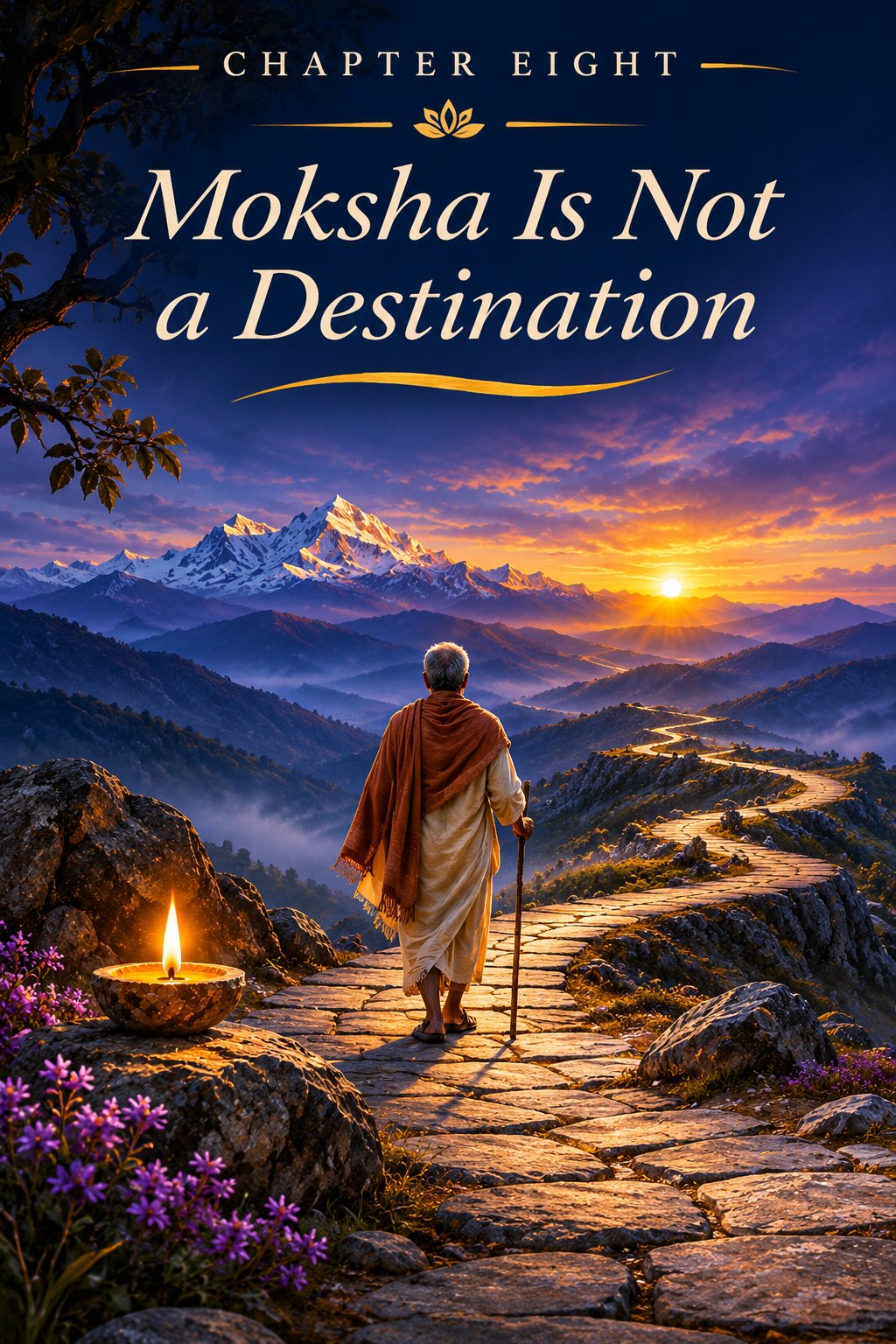
For much of my life, I thought freedom was something I had to earn.
I thought moksha—liberation—was the end of a road. Something to be attained through discipline, effort, knowledge, and inner evolution. A finish line for the soul. But as I’ve grown quieter, as I’ve sat longer in the company of my own Self, I’ve realized something powerful:
Moksha is not a destination.
It is a recognition.
A remembrance.
Freedom isn’t something I’ll arrive at someday—it’s something I uncover, moment by moment, when I stop clinging to what is not real.
The body? It ages.
The mind? It wanders.
The world? It spins, endlessly full of demands, illusions, and noise.
But the Self?
The Atman?
It just is.
Vedanta doesn’t ask us to reach God. It asks us to realize we’ve never been separate. That the wave was never separate from the ocean. That what we seek, we already are.
It’s taken me years—and many losses—to start seeing this. The shedding of identities. The release of roles. The silence that came not as a punishment, but as a gift.
Moksha isn’t just a concept in scripture.
It’s what I touch when I sit in stillness and know:
I am not this moment.
I am not this thought.
I am not even this story I am telling you.
I am the awareness behind it.
The light watching the flicker of every scene.
And yet, that light lives in all things—in music, in memory, in laughter, in service, in surrender. Moksha is not an escape. It’s an embrace of the real. It’s not detachment from the world, but detachment from illusion.
Chanakya gave me the fire.
Vedanta gave me the mirror.
And life gave me the stage to bring them together.
I no longer chase freedom.
I taste it in every moment I stop resisting.
In every moment I return to stillness.
In every breath where I remember: I am not becoming—I already am.
This is not a race to transcend life.
It is a deepening into it.
Until the “I” dissolves, and what remains… is peace.
← Previous: Chapter Seven · Table of Contents · Next: Chapter Nine →

