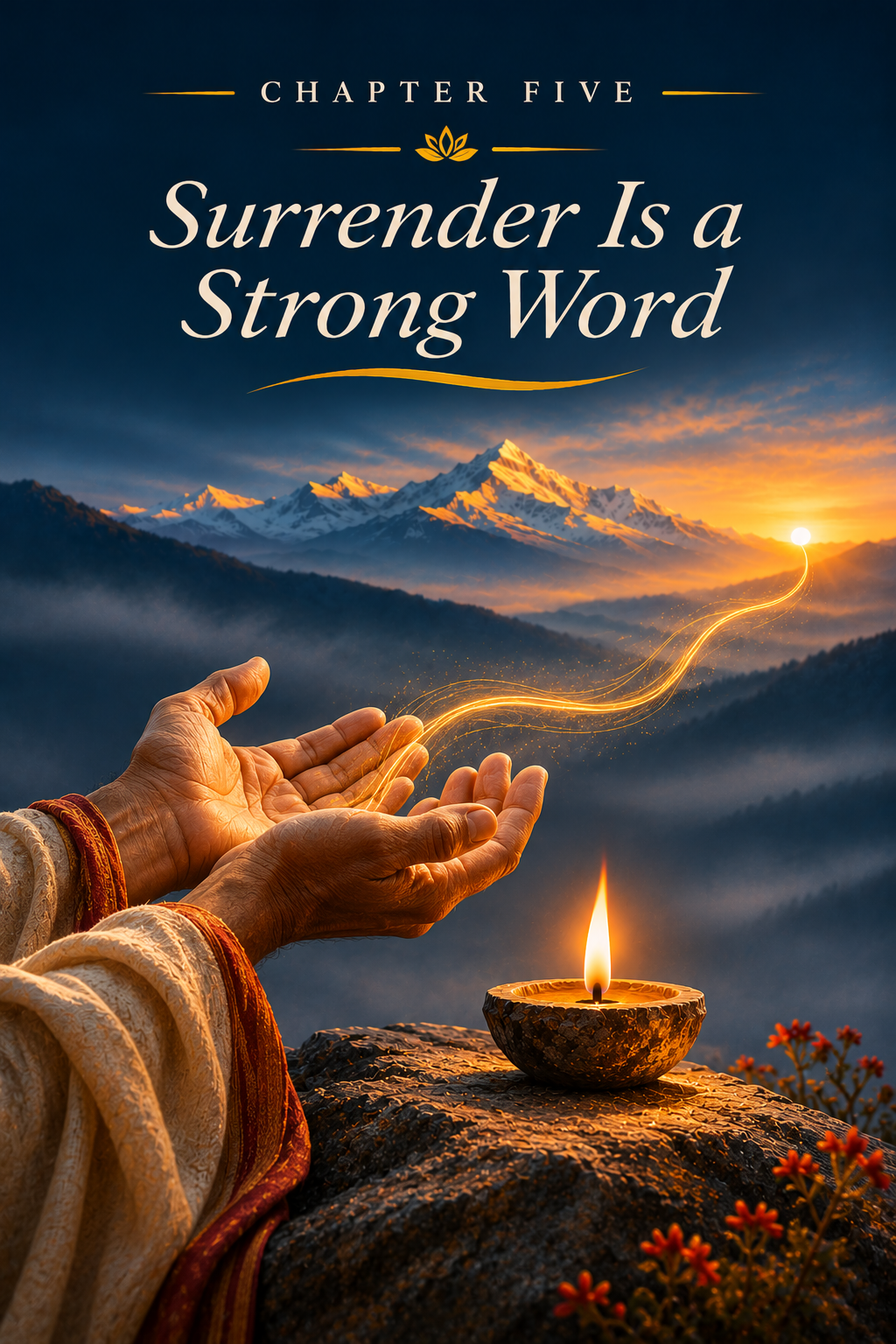
Surrender.
It’s a word people toss around too easily. They equate it with giving up, with defeat. But real surrender? It’s not weakness—it’s a kind of bravery the ego doesn’t understand.
At first, I resisted the idea. I had survived too much, fought too hard. I didn’t want to “surrender”—I wanted to overcome. But slowly, through stillness and weariness and the quiet erosion of old beliefs, I began to realize:
Surrender is not the end of the fight.
It’s the decision to stop fighting what was never yours to control.
I began to notice that the more I clung—to identities, expectations, timelines—the more exhausted I felt. And yet, when I allowed myself to just be, to release the weight of “should,” I felt lighter. Not happier, necessarily. But clearer.
Vedanta doesn’t ask us to be passive. It asks us to see truly. To see that the waves of our life—our triumphs, our traumas—are not who we are. They move, but we remain. That unchanging awareness beneath the storm? That’s where surrender leads.
And in that space, something sacred began to grow: trust.
Not blind optimism. Not spiritual bypassing. But deep trust. That life was unfolding exactly as it must. That my role was not to control it—but to align with it.
That I could grieve and still be grounded.
That I could laugh through pain and still be sincere.
That I could be uncertain and still walk forward with grace.
Chanakya taught that a wise person knows when to step back and when to advance.
Vedanta taught that the Self needs neither.
Because it already is.
And so I began to surrender—not to fate, not to illness, and not to defeat. I was surrendering to Mahadev. In that devotion, the teachings about the deeper Self no longer felt merely philosophical. They became personal: a trust that I could live, love, and act without needing to control everything that followed.
The Grace of Surrender
I did not come to this understanding alone. Friends walked beside me, each bringing something different to my journey. Some had endured their own suffering and understood what it meant to face uncertainty. Some listened. Some challenged me. Others offered laughter, kindness, or the quiet reassurance of their presence.
Through those conversations, I kept returning to vairagya—the freedom of loosening my attachment to what I could not keep or control. In the beginning, I resisted. I had spent a lifetime building, leading, loving, and fulfilling responsibilities. Letting go seemed to contradict everything I believed had given my life meaning.
One question stayed with me: had I not already become the man I wanted to be? Had I fulfilled my obligations to others? And if so, why did I still feel there was something left for me to do?
These were uncomfortable questions, and I was grateful for friends who were willing to ask them. They invited me to consider whether a desire to accomplish one more thing could become another attachment. But what I was experiencing was not a restless pursuit of achievement. I was not bargaining for more time or a different life. I was learning to trust Mahadev with the life I had.
I had not surrendered to illness. I had not surrendered to the wheelchair, to loss, or to defeat. I was surrendering to Shiva.
That did not erase my love for Neha and Anokhi. It did not diminish my gratitude for the friends who had stood beside me. It did not extinguish my desire to finish this book, or to offer whatever words and kindness I still could. I could continue to love and to act without believing that peace depended on completing everything.
And yes, there is something else. Something I feel remains for me to do, though I cannot tell you what it is. It has no name, no deadline, no plan. Once, such uncertainty might have unsettled me. Now it does not.
I feel no urgency. No restlessness. I am completely at peace.
I believe that whatever is meant for me to accomplish will unfold in its own time. That is an expression of my faith, not a claim that I know what tomorrow holds. My trust rests in Mahadev, not in my ability to predict the future.
My friends saw things in me that I sometimes struggled to recognize: dignity, grace, humility, and the possibility of finding freedom from the need to prove myself. Their encouragement mattered, as did their questions. They did not all offer the same wisdom, but together they helped me look more closely at my life.
I remain grateful to those who guided, challenged, encouraged, and cared for me. No one person walked this path for me; and I did not walk it alone. Their friendship helped me discover the difference between releasing control and withdrawing from life.
Perhaps this was the lesson I had been approaching all along: surrender did not require me to abandon life. It invited me to release my grip on how life must unfold.
I had not surrendered my love for living. I had surrendered to Shiva.
This is not a chapter of closure. This is a chapter of opening—to mystery, to presence, to life not as I planned it, but as it is.
And in that surrender,
I began to feel whole—not in spite of everything I had lost—
but because I had finally stopped pretending I needed more.
← Previous: Chapter Four · Table of Contents · Next: Chapter Six →

